Monday - Friday 07:30 - 17:30, Saturday 07:30 - 16:00
Chevron Floor Sanding and Restoration in Hampstead, NW3
Back to Portfolio
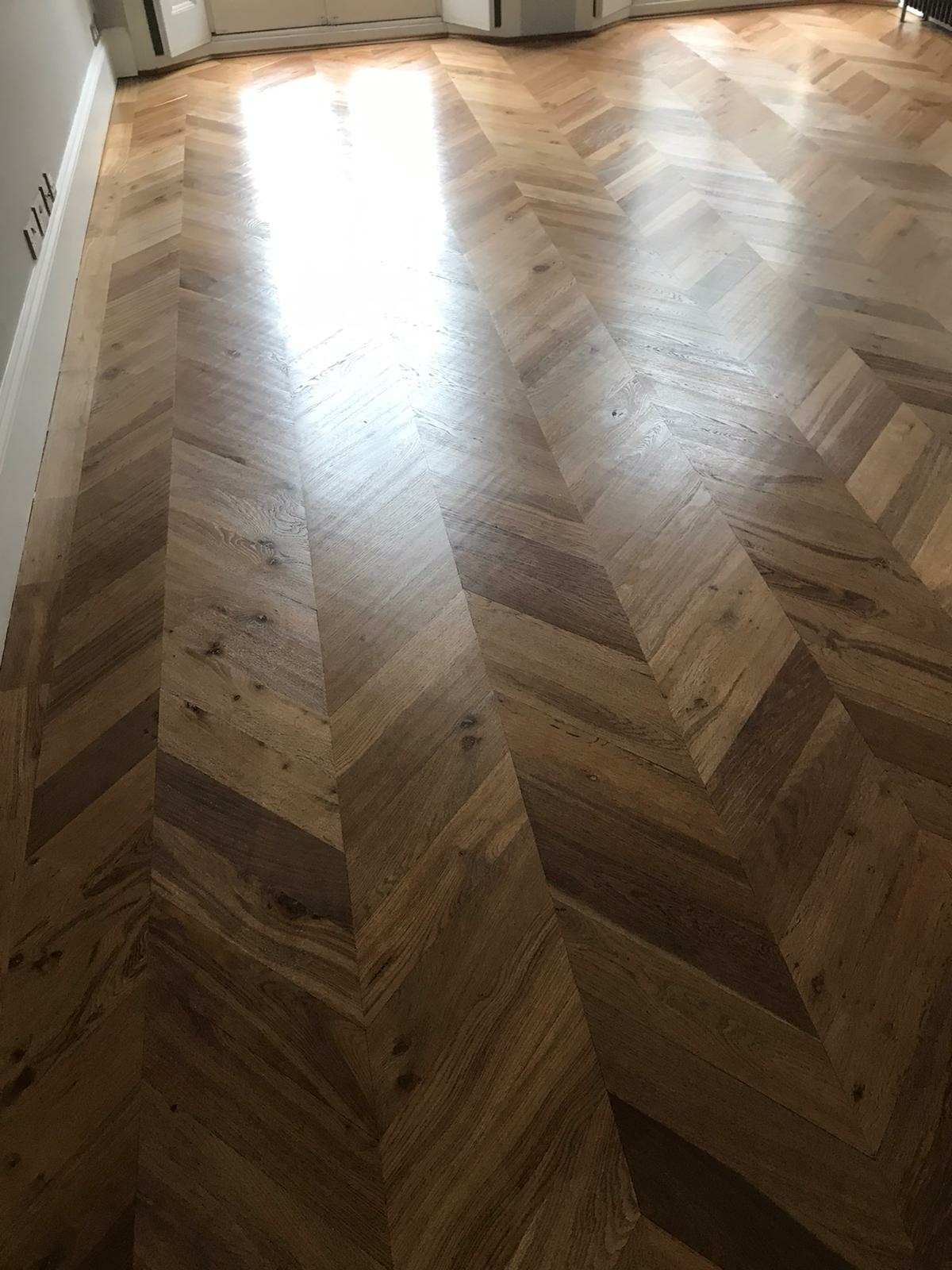


Chevron Floor Sanding and Restoration in Hampstead, NW3
This Victorian townhouse in Hampstead required comprehensive sanding and restoration of its original parquet flooring across the ground and first floors. The chevron pattern had been sealed and darkened over decades, obscuring the grain beneath. We stripped back to bare wood and brought the floor back to its original condition.
Work carried out
- Full sanding of chevron parquet flooring (180 square metres)
- Progressive grit sequence from 40 to 120 grit
- Edge sanding and corner work by hand
- Dust extraction and air filtration throughout
- Wood stain application to match original colour
- Lacquer finish in satin sheen
- Threshold and transition work
About the project
The owner had lived with darkened floors for years, unaware of the quality timber underneath. When they started renovation work on the property, they decided to investigate what lay beneath the old finish. Sectional sanding revealed beautiful oak with consistent grain throughout. The challenge was the chevron pattern itself, which meant sanding at angles rather than with the grain in most areas. This requires careful machine handling and frequent checks to avoid creating uneven surfaces or cross grain scratching.
We worked methodically through the sanding sequence, spending extra time on the 80 and 100 grit stages to ensure uniform results. The chevron's geometric pattern actually worked in our favour during staining, as it created natural visual breaks that helped us identify any inconsistencies. The final finish was applied in two coats of satin lacquer, which suits Victorian properties better than gloss and sits well with the period character of the house.
About our Hampstead, NW3 service
Hampstead has some of London's finest period property stock. Most houses are Victorian or Edwardian, built between 1860 and 1910, with solid timber floors throughout. These properties typically feature parquet, chevron or herringbone patterns in reception rooms, straight board flooring in bedrooms, and pine in service areas. The quality of timber work is consistently high, which means floors usually respond well to restoration. The main issue is that decades of accumulated finishes can obscure the original beauty of the wood. Owners investing in full house renovations often choose to restore rather than replace these floors, as the craftsmanship is genuinely difficult to replicate in new work.
We've completed over 40 projects across Hampstead in the past five years, from substantial Georgian properties on The Hill down to smaller Victorian cottages in the conservation areas. Each property tends to have its own character, and timber finishes vary depending on original use and how they've been maintained. We regularly work alongside architects and interior designers who specify restoration as part of larger schemes. The area's reputation for quality homes and high standards means clients expect careful, professional work, which suits our approach.
Frequently asked questions
How much does floor sanding cost per square metre?
Sanding costs typically range from £25 to £45 per square metre, depending on the floor condition and pattern complexity. Parquet and chevron patterns fall toward the higher end because the angles require slower machine work and more careful hand finishing. Victorian property floors with old varnish buildup cost more to prepare than floors with single finishes. Our quotation always includes sanding, staining, and two coats of protective finish.
How long does the sanding process take?
A straightforward room of 20 to 30 square metres typically takes three to four days from start to finish. Larger projects like this Hampstead property took two weeks across both floors. The timeline depends on floor condition, pattern complexity, and how many coats of old finish need removing. We always complete work room by room so you can use parts of the property again once each section is done.
Is the sanding process dust-free?
Our process is not completely dust-free, but we use industrial dust extraction connected directly to the sanding machines, which captures around 95 percent of dust at source. We also set up negative air pressure systems with HEPA filtration in the work area. Clients should still expect some fine dust migration into adjacent rooms, so we recommend removing soft furnishings and closing internal doors during work. Most of the remaining dust settles within 24 hours of work finishing.
Project Gallery